| WWW.SEABEAN.COM HOME PAGE | SEA-BEAN GUIDE MAIN PAGE | E-MAIL Contact Info |

or Coco Fesse or Seychelles nut
Lodoicea maldivica
See the Feb. 17, 2019 CBS News video & story: The Seychelles Islands' unique "Love Nuts"
| Scientific Classification | Donation Wanted! | |
|
Kingdom: Division: Class: Order: Family: Genus: Species: |
Plantae Magnoliophyta Liliopsida Arecales Arecaceae Lodoicea maldivica |
The Nature Conservancy's "
Blowing Rocks Preserve" is located on the shore of the Atlantic Ocean in Hobe Sound, Florida and is seeking the donation of a Coco-de-Mer to complement their educational displays and presentations of sea-beans and ecology. Visit their website to see all they've done, and what they are doing today to preserve the habitat and ecology of the area and to educate the public regarding the value of these and other coastal areas. would forever support the efforts and goals of this great organization! |
|
The Coco-de-Mer palm produces the largest seed in the world and is endemic to only two of the 115 Seychelle Islands.
The plants have separate sexes and thus there are
male trees and female trees. These large seeds may weigh up to 50 pounds and have historically been found floating in the Indian Ocean, being known to explorers long before the parent plants were discovered. They were originally named only from floating seeds; erroneously thought to have originated in the Maldive Islands, they were assigned the scientific name "maldivica". In days of old it was rarely found washed ashore on the coast of India and viewed as the female counterpart to the shankara stones on Hindu alters. It was also used as a medicine and as an aphrodisiac. Today, the seed is so valuable and coveted by so many that it's chances of being allowed to fall into water and drift away have to be extremely small! Books on the Coco-de-Mer: |
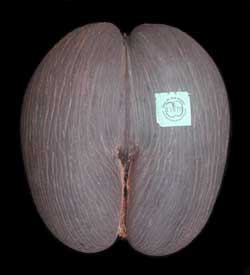 "Frontside" |
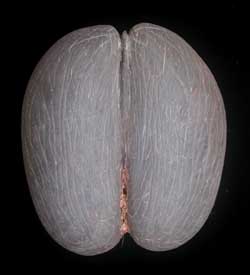 "Backside" |
Note the government's serialized tag on the seed, as their export is strictly controlled.
For a multitude of photos of the Coco de Mer, click here!
For a picture of Elizabeth Tashjian, "The Nut Lady" (1912-1/28/2007), holding a Coco de Mer, click here!
The following information regarding the Coco-de-mer is from
Wikipedia, the free encyclopedia.
| The Coco de mer (Lodoicea maldivica (J. F. Gmelin) Persoon, Arecaceae) is a palm tree that grows on the islands of Praslin and Curieuse in the Seychelles. It is the sole member of the genus Lodoicea. Its fruit, weighing up to 22 kg and measuring up to 50 cm across, contains the double coconut, which is the largest seed in the world, and is so called because it has two lobes each resembling a coconut. It is an example of a sea-bean or drift seed, which is a seed that is designed to be dispersed by the sea. It is also called the coco fesse, sea coconut and Seychelles nut. The sailors who first saw the double coconut floating in the sea imagined that it resembled a woman's disembodied buttocks. This fanciful association is reflected in one of the plant's archaic botanical names, Lodoicea callypige Comm. ex J. St.-Hil., in which callipyge is from Greek words meaning 'beautiful rump'. Other botanical names used in the past include Lodoicea sechellarum Labill. and Lodoicea sonneratii (Giseke) Baill. Until the true source of nut was discovered in 1768, it was believed by many to grow on a mythical tree at the bottom of the sea. The coco de mer is now a rare protected species. The genus name is from Lodoicus, the Latinised form of Louis, in honour of King Louis XV of France. |
The following photos are of a Coco de Mer which has been intricately and exquisitely carved.
Presently belonging to Anthony Rickard, it was purchased by his late Father in Andover, Hampshire, England in the 1960s.
It still has its label reading "double coconut 40/-" i.e. £2.00. Back then £2 would have bought about £60 of today's value.
Anthony says that "The figures seem to alternate between some sort of bishop - at least the hat looks like a mitre - and a merman!"
If anyone knows any information about the carvings, please email me!
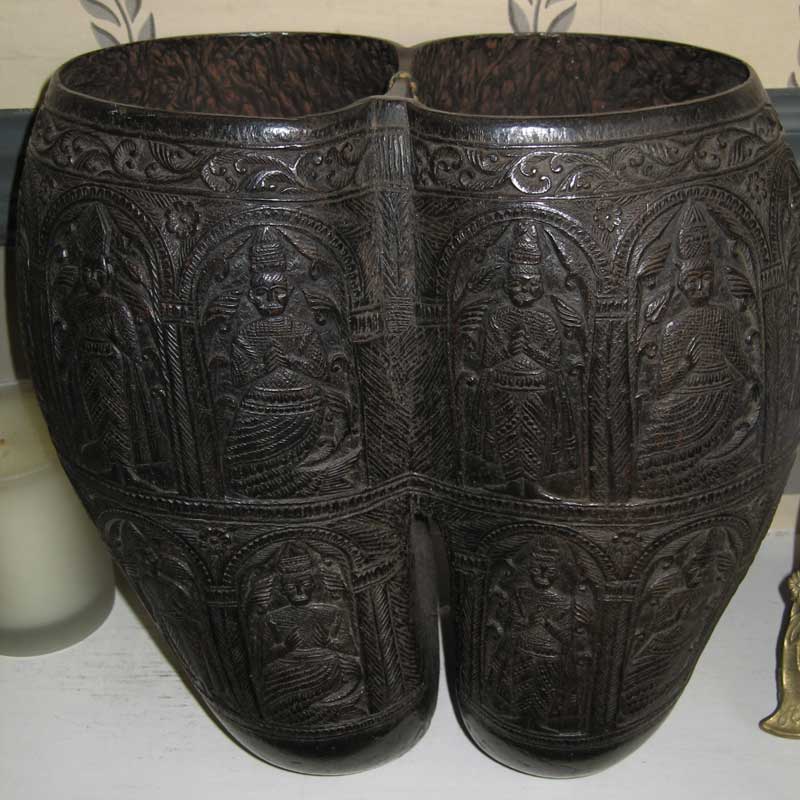
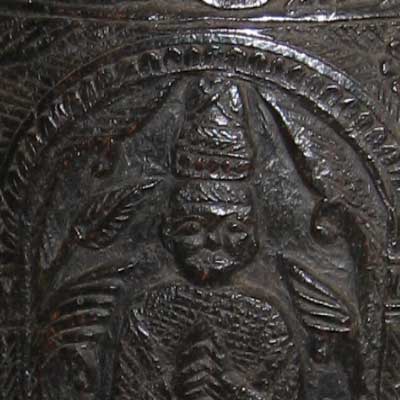
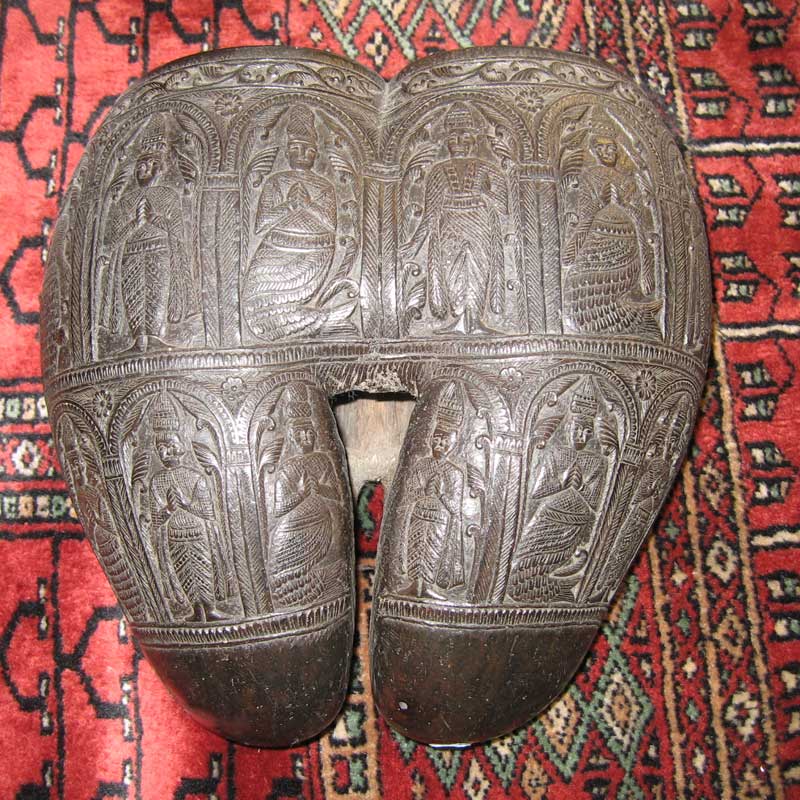
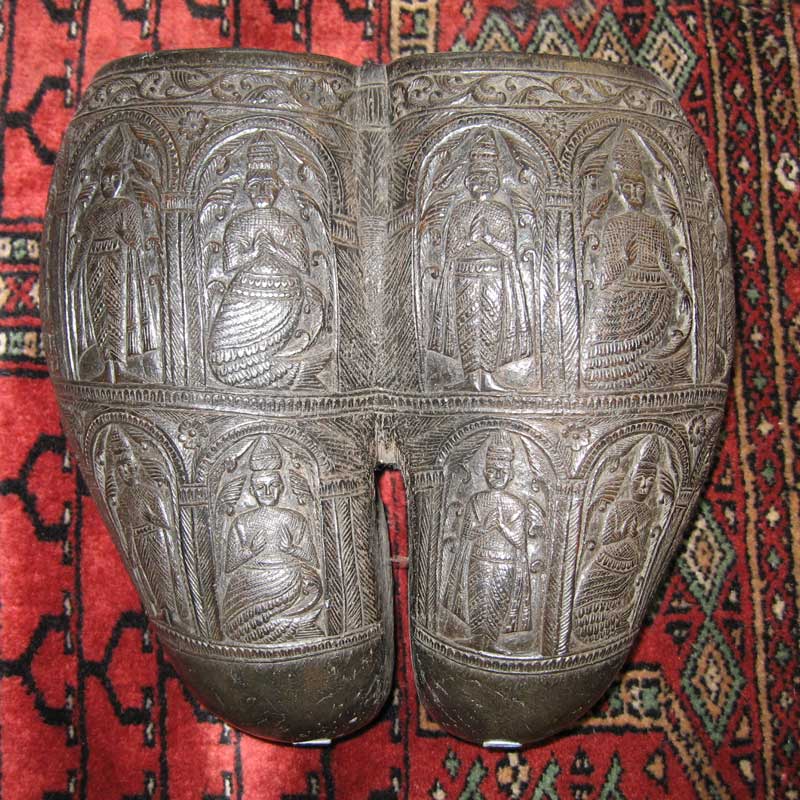
Photos courtesy of Anthony Rickard
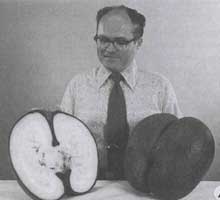 Dr. Gunn with an opened specimen. Photo from World Guide, pg. 24 |
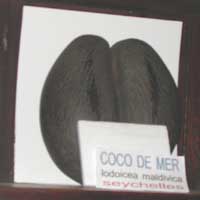 Specimen on display at the home of Thomas Edison, Fort Myers, Florida USA. [note: no plants growing onsite] |
The Coco de Mer was also featured on a 1905 postcard of Mahe Island, Seychelles.
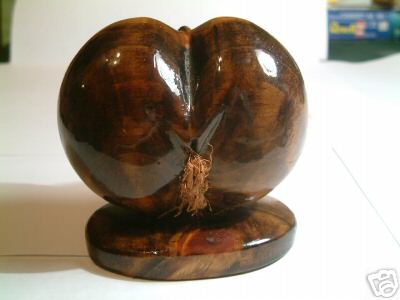
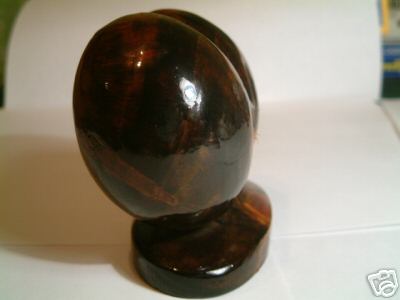
Wooden Coco-de-Mer ornament from the Seychelles
It is 8.5 cm tall, 9 cm wide, and 6 cm deep
eBay item 6227305664; sold for $15.53 on November 23, 2005
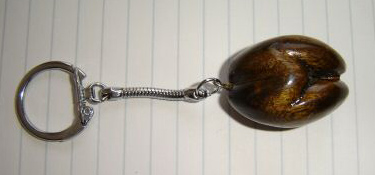 Keychain, eBay item number 6521379478; sold for $5 on March 28, 2005 |
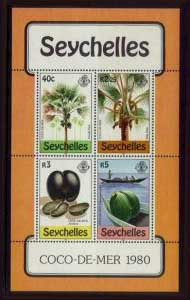 Seychelle Islands Postage Stamps |
Links
|
|
 Return to Top

